
Why modern leaders need to stop conducting and start synthesising. An introduction to the Dynamic Strategies Framework and the Modular Organisation.
In the rush for efficiency, many leaders look for shortcuts. We grab the latest methodology, implement a rigid framework, or look for an AI-generated quick fix to solve complex organisational problems.
But deep down, honest leaders know the truth: Chaos is a feature, not a bug.
In many companies, the reality is a fragmented system of silos. The software developers swear by Agile and Scrum. The business developers live in the world of Design Thinking. Meanwhile, management demands the control and predictability of Six Sigma. You get the idea; you can add any methodology you want.
Each department is playing its own instrument perfectly, but they are playing different songs.
What they need – and what a modern leader must facilitate – is not to force everyone into the same rigid method, but to connect these valuable instruments dynamically. You cannot ‘conduct’ this complexity from a podium. Instead, leadership requires a different kind of craft.
This is the core of the Dynamic Strategies Framework (also known as the Music Thinking Framework).
The Organisation as a Modular Synthesizer
Stop viewing your organisation as a classical orchestra where everyone sits in a fixed chair, with a fixed score. Instead, view it as a Modular Synthesizer. Let me explain.
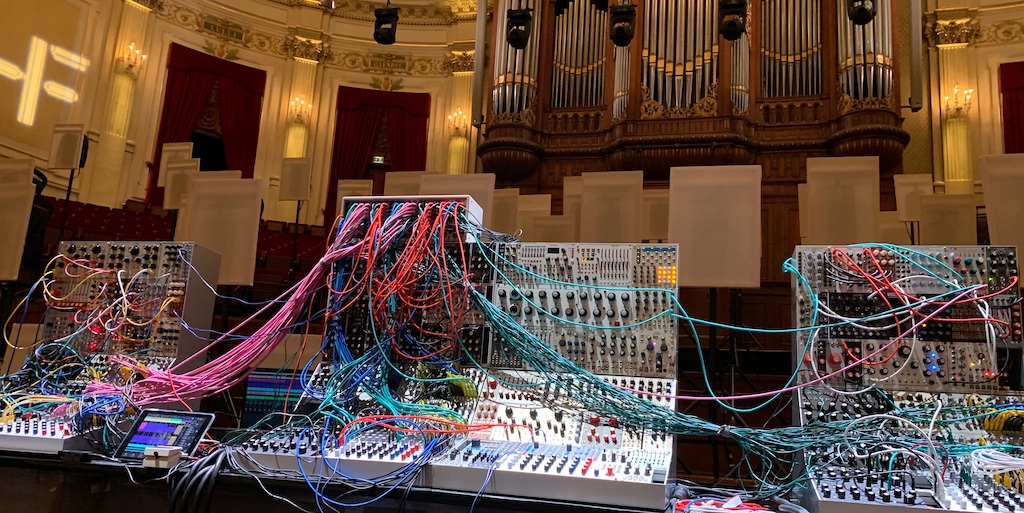
In a modular system, the magic happens in the connections. You have various inputs (market data, employee feedback, cultural values) and outputs (products, brand reputation, impact). The leader’s job is not to dictate every note, but to ‘patch the cables’ – to connect the right ‘instruments’ (tools, methods, departments, people) to create a meaningful sound.
This approach allows you to act systemically. You connect the Brand (who you are and how others see you based on your actions), the Organisation (how you work), and the Human Relations (how you co-create) into one cohesive system that operates from the lowest operational level to the highest strategic vision.
The ‘Desirable Difficulty’ of Craftsmanship
Adopting this framework is not a shortcut. It is what educators call a ‘desirable difficulty’.
Just as learning an instrument requires practice, mastering the Dynamic Strategies Framework requires dedication. It asks you to bring your ‘whole self’ to work. It asks you to stop looking for a ‘tool’ to do the thinking for you, and instead learn the craft of synthesising – patching the right instruments for the right players, for the right moment.
Why This Matters Now
We live in an era of ‘tool fetishism’. We use Agile, Lean, or Design Thinking as isolated patches. But without a thinking frame to connect them, they are just noise.
The Dynamic Strategies Framework provides the ‘Thinking Frame’ – the underlying logic that allows you to use these tools effectively. It helps you decide when to play fast (Agility), when to listen deeply (Empathy), and when to release your innovation (Remix).
If you are a leader who is tired of the quick fix and ready to master the craft of meaningful business, it is time to stop conducting into the wild, and start composing on different levels.
How to Start
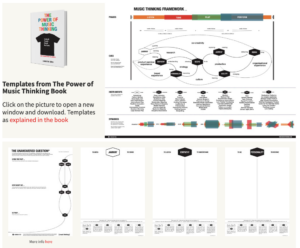
Download the Dynamic Strategies Framework and, if you want, the other templates as well.
The framework has four sections: Phases, Cues, Instruments, and Dynamics.
Let’s focus on Cues and Instruments (so ignore the colours for now). Note: Instruments = methods and/or tools.
1. Pick the tools and methods that you (want to) use. The instruments section shows only a selection of possible instruments, so add instruments as you like.

2. Pick your most important cue (or triangle of cues, based on your most pressing question) and connect the related instruments. For example, if you work on the culture triangle, you can use the Golden Circle by Simon Sinek and realise that this connects with three cues: Personality (Why), Score (What), and Agility (How). Start with a few instruments to keep it simple.
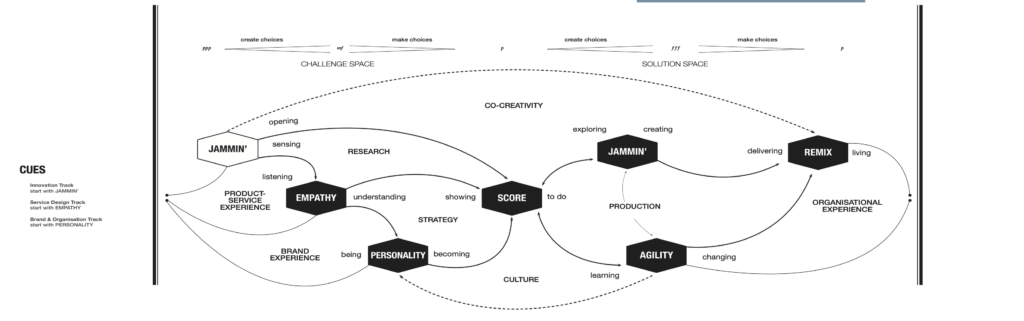
3. Discuss what this means for your organisation. Check how you are organised to keep this in flow.
If you want to do it in a workshop, you can also use the Unanswered Questions template to define your most pressing question and use the cue templates to make notes. They are all free to download and use.
Your Mindset: As a Leader, You Need to be the ‘Chief Listener’
The cliché of the CEO as a Conductor is tired. It implies that the score is already written, and the leader is the only one who sees the big picture.
In the Dynamic Strategies Framework, the leader often acts as the combination of Composer, Orchestrator, and Player, depending on the genre you are working in.
In this sense, you become the Synthesizer – the person who brings distinct elements together to form a coherent whole.
This doesn’t mean you dictate the music. It means you are the Chief Listener – you lead by listening. You absorb the signals from your environment – you embrace the dissonance, the noise, and the harmony. You translate these signals into a Score (a vision or purpose) that makes sense to everyone else. And sometimes you facilitate a team to create a Score.
This role is fluid. Depending on the dynamic of the challenge, you shift your position:
- The Producer (Pop, Rock, Hip Hop): When you need to ship a product, you focus on the technical mix and facilitating the process so others can shine. You ensure the ‘Remix’ works for the audience.
- The Improviser (Jazz, Blues, Baroque): When facing the unknown, you step up and play inside the circle, iterating and listening in real-time. This is essential for the ‘Play’ phase of innovation, that is overlapping the other phases.
- The Master (Folk, Indigenous): When you need to build culture, you become its custodian, teaching through presence rather than instruction. You help the organisation ‘Tune’ itself.
- The Conductor (Classical, Orchestral): Yes, and sometimes you have to hold the space, know how the score has to sound, and you turn your back to the audience, not out of disrespect, but because you show the team you are there for them and listen and direct a sound that is different to every single player, but one great experience for the audience.
Does this resonate with you? Three Next Steps you can take
1. Listen to the podcast that explores parts of the above:
- Modular Strategies: Modular Strategies with Rikkert Achtereekte
- Conductor, yes or no: Leading an Orchestra of Leaders with Harvey Seifter
- Conducting Design: Conducting Design with Raf De Keninck
2. get an explanations of some related templates:
3. Buy the book for a step-by-step introduction and background:
See how this framework resonates with global leaders
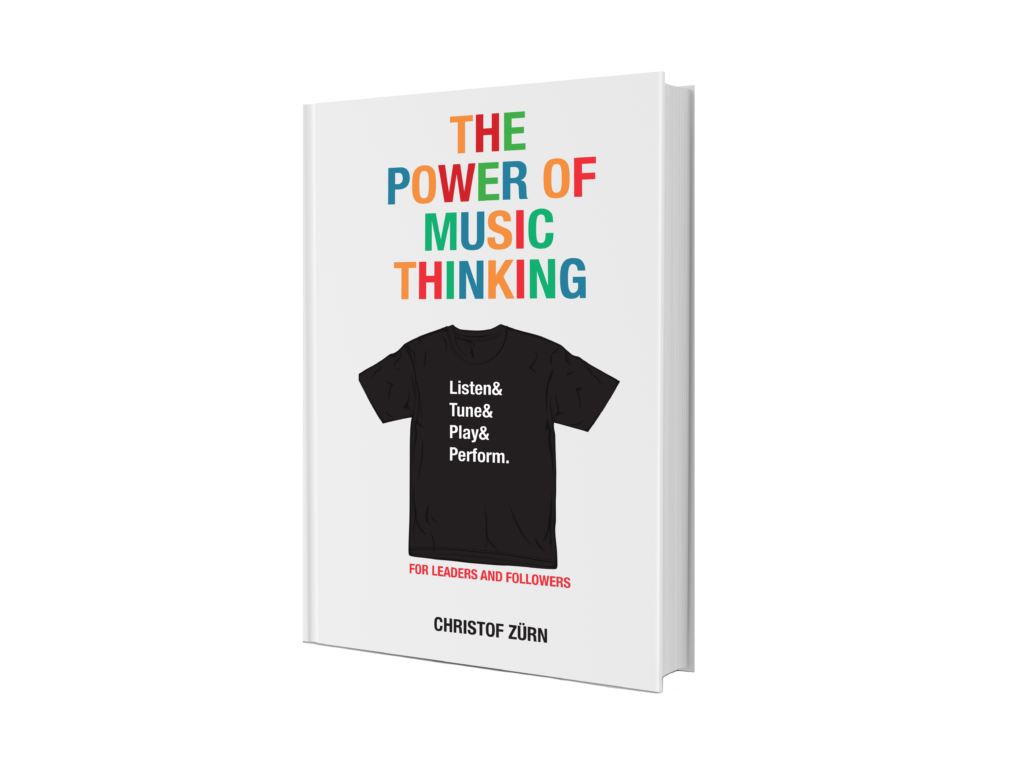
“Christof has condensed his message on co-creativity, design and organization in a dense book with a unique visual language. Read it on your next flight or train journey and arrive with fresh ideas and powerful insights to supercharge your work, no matter the field.”
PANOS PANAY IS CO-PRESIDENT AT RECORDING ACADEMY/GRAMMYS
“Music has a magical transformative power. Yet, how to tap into that power is something of a mystery. Christof Zürn shows us the way. Using his extensive knowledge of music, creativity and management, his book, Music Thinking provides an inspirational guide for leaders and followers, to think and act different.”
NICHOLAS IND IS A PROFESSOR AT KRISTIANIA UNIVERSITY COLLEGE AND THE AUTHOR OF 17 BOOKS
More info on how to buy The Power of Music Thinking book

Contact
Send me an email to christof at musicthinking.com or DM me if this resonates with you and you would like to have more insights and a PDF with tools and questions for each cue.