This is my epiphany story for 2026, January 6th, this year, it is about maintenance.
Epiphany Story 2026
I thought I was on time.
It is 10 minutes to nine in the morning, and I am at the Kongobu-ji Temple in Koyasan (Japan) to attend the morning meditation.
It is the end of my second week in Japan. I am on a journey of listening and learning about the shakuhachi flute, stone gardens and everything Japanese. I had the opportunity to meet extraordinary people; the shakuhachi grandmaster Fukuda Sensei (thanks to my teacher Hélène, I could attend two lessons), join an exceptional group of jinashi shakuhachi players in Osaka and walk with a priest and his flute through Nara.
But now, I have finally arrived at the spiritual centre of Japanese (Shingon) Buddhism – Koyasan.
I paid the entry fee and asked for the meditation session, which was scheduled to start at nine o’clock. However, there was some confusion, which I did not understand, and a sense of urgency. The friendly person behind the counter asked a monk to guide me further, and we did a kind of speed walking exercise through the gangways of the temple. I finally understood I had to purchase extra tickets for the meditation in the gift store, which was located in a distant part of the temple. Then the monk guided me quickly across more gangways to the meditation room.
It was a morning rush, and my heart was beating quicker. I was a bit worried and thought I would be late and enter a room of maybe 30 people, ready for meditation and disturb everyone in their preparation.
At 9 o’clock sharp, I entered the room. There was a friendly smiling priest in his beautiful saffron robe – and there were no other people in the room besides the two of us.
It was a remarkable moment and a personal treat to experience Ajikan meditation at this place in a one-on-one setting. The meditation is focused on visualising the Sanskrit letter A and vocalising the sound of that letter, accompanied by a singing bowl. After the meditation, I had a chat with the priest, and he shared pictures on his mobile phone about a secret ritual in Nara just the week before. When we got out of the dojo, he pointed to the zen garden (karesansui) that was undergoing maintenance today.
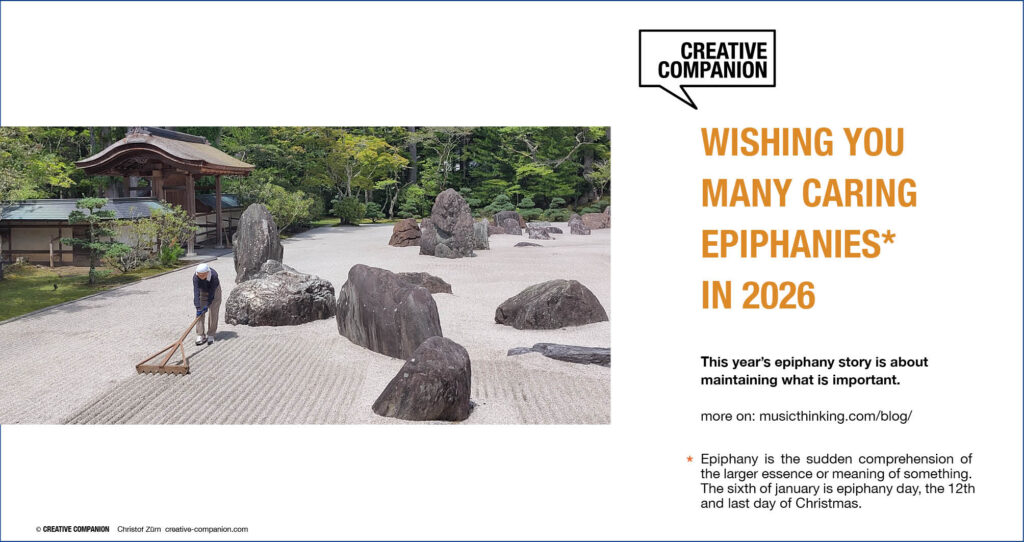
From a distance, I already heard the soothing sound of wood on gravel stones, and as I came closer, I could see a gardener with his large wooden seven-tooth rake drawing fresh lines into the stones. Three teeth of the rake were locked in the already drawn grooves, and four new grooves were drawn in a long parallel move. A major challenge of this work is manoeuvring without leaving footprints, ensuring that the final design remains pristine. For the gardeners, this repetitive, precise labour is not merely a chore to counteract wind and rain, but a form of active meditation that clears the mind and fosters a state of pure concentration.
Banryutei is Japan’s largest dry landscape garden, a 2,000-square-meter expanse constructed in 1984. Its 140 granite stones are arranged to symbolise two dragons emerging from a sea of clouds to protect the temple, creating a stylised miniature universe designed to aid meditation by stripping nature to its bare bones.
The beauty of this landscape lies in its continuous renewal, a process I was so happy to witness firsthand. I realised that this was a special moment because the priest stayed around and took pictures of the gardeners maintaining the gravel.
Listen to the maintenance sounds
I stayed for a long while, took pictures and made several recordings of the whole environment. The sound of labour mixed with the nature sounds of cicadas and birds, the soft and distant talking of monks and visitors.
You can experience this rare moment, and the gardener drawing his wooden rake over the gravel. A unique sound of stones and wood. In the beginning, you can hear that he stops for a moment, takes some breath and then goes further. The second time, he draws the whole line without stopping. As I gave him a thankful bow for his work, he answered with Arigato gozaimasu! (in the middle of the recording).
Listen here to an audio postcard of my sound experience. Put on your headphones, and read further.
Does my life require maintenance?
Enchanted by this maintenance performance, I thought about how maintenance has a role in my life. What are my maintenance moments? Is it the morning ritual of yoga, the daily shower, or the rehearsal of shakuhachi and saxophone? Or preparing a workshop, a lesson or a meal? Checking the system before recording a podcast, or (re)reading a book, a text, or an assignment? Is it physical and mental, or just one of the two?
How is this for you? Six questions for the new year:
- What do I have to maintain?
- What rituals work for me?
- What relation needs more care?
- What is the value of maintenance?
- Which long lines should be (re)drawn?
- What if I don’t maintain my [fill in whatever you want]?
With these questions for 2026, I wish you all the best for this year, may maintaining your life be a good cause.
And if our personal relationship needs a maintenance call, please don’t hesitate.
Happy Epiphany!
Christof Zürn
What is Epiphany?
A collection of different meanings of Epiphany – what does Epiphany mean?
“Western churches generally celebrate the Visit of the Magi as the revelation of the Incarnation of the infant Christ, and commemorate the Feast of the Epiphany on January 6″. (wikipedia)
But there are more meanings of epiphany; here a selection:
- EPIPHANY is the sudden realisation or comprehension of the (larger) essence or meaning of something.
- PHILOSOPHICAL meaning: having found the last piece of the puzzle and suddenly seeing the whole picture.
- ARCHIMEDES Eureka! I found it!
- EINSTEIN was struck as a young child by being given a compass, and realising that some unseen force in space was making it move.
- DARWIN An example of a flash of holistic understanding in a prepared mind was Charles Darwin’s “hunch” (about natural selection) during The Voyage of the Beagle.
- JAMES JOYCE Referring to those times in his life when something became manifest, a deep realisation, he would then attempt to write this epiphanic realisation in a fragment. Joyce also used epiphany as a literary device within each short story of his collection Dubliners (1914) as his protagonists came to sudden recognitions that changed their view of themselves or their social condition and often sparking a reversal or change of heart.
- In RELIGION it is used when a person realises their faith or when they are convinced that an event or happening was really caused by a deity or being of their faith.
- WESTERN CHRISTIAN Religion: The adoration of the magi, represented as kings, having found Jesus by following a star 12 days after christmas.
- HINDUISM epiphany might refer to the realisation of Arjuna that Krishna (a God serving as his charioteer in the “Bhagavad Gita”) is indeed representing the universe.
- In ZEN, kensho describes the moment, referring to the feeling attendant on realising the answer to a koan.
- BUDDHISM Buddha finally realised the nature of the universe, and thus attained nirvana.
- WILLIAM BURROUGHS is talking about a drug-influenced state, a frozen moment when everyone sees what is at the end of the fork (naked lunch).
- EPIPHANIES is the thirteenth episode of the second season of the reimagined Battlestar Galactica television series.
- EPIPHANY is a web browser for the GNOME graphical computing desktop.
- HIERONYMUS BOSCH painted the adoration of the magi around 1495.
- HOMER SIMPSON has an epiphany, after visiting a strange Inuit shaman and realises he has to save the town from Russ Cargill’s plans to destroy Springfield.
- The last page of THE WIRE magazine with surprising sonic stories about music is called EPIPHANIES.
- Interesting: if you search for Epiphanies or Epiphany on TWITTER many people talk about that they (just) had an epiphany, but don’t exactly say what it was.
Since 2011, Christof Zürn CREATIVE COMPANION has been sending out epiphany greetings on the 6th of January.
More on Japan:
- Podcast with my teacher Helene: The Sound of Nature
- Video performance of Teruhisa Fukuda: https://www.youtube.com/watch?v=CEcl1_a4YOw
- More audio postcards: From Japan with Love