Explore how Yoko Ono’s mental scores, Schumann’s inner melodies, and second-order cybernetics expand active listening beyond audible sound to transform how we think and lead.
What links a 19th-century Romantic composer with a 20th-century Fluxus avant-garde artist?
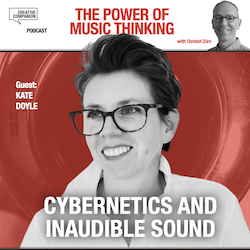
In Episode 76 of The Power of Music Thinking, host Christof Zürn sits down with Kate Doyle – Assistant Professor of Music in the Department of Arts, Culture & Media at Rutgers University-Newark and author of Listening at the Edge of Form.
While most discussions about music focus strictly on audible performance, this conversation highlights a far more intriguing realm: composition as a way of thinking. Kate brings together two radically different creators – Robert Schumann and Yoko Ono – to demonstrate how scores can be written directly for human cognition.
In his Humoreske op.20, Schumann notated a distinct “inner voice” (Innere Stimme) on a separate stave in the piano score – a line explicitly intended never to be struck on the keyboard, but performed entirely in the imagination. Over a century later, Yoko Ono published her conceptual text scores in Grapefruit, creating “music of the mind” through precise instructions such as Bell Peace, where the reader mentally lowers the dynamic of an imagined bell until it fades entirely through being forgotten.
We explore how these composition techniques – alongside the pioneering text scores of Pauline Oliveros and the vocal architecture of Meredith Monk – treat human thought itself as a musical modality. From ancient Indian Vedic sound theory to second-order cybernetics (observing the observer), Kate shows why expanding how we compose and perceive thoughts can transform collaboration, empathy, and leadership.
Listen to: Cybernetics, Yoko Ono and Inaudible Sound with Kate Doyle
You can also listen to it on Spotify, Apple, and YouTube or wherever you listen to podcasts.
Key Takeaways & Themes
- Schumann and Yoko Ono in Dialogue – Discover why placing Schumann’s unplayed “inner voice” alongside Yoko Ono’s instruction scores reveals mental score-reading as a rigorous, experimental composition practice.
- Text Scores and Conceptual Composition – How artists like Yoko Ono, Pauline Oliveros, and Meredith Monk challenge traditional notation by using language to direct perception, imagination, and attention.
- Second-Order Cybernetics – The practice of listening to listening and observing the observer – taking responsibility for our own descriptions when navigating complex systems and team dynamics.
- Indian Vedic Gradations of Sound – Ancient music theory where sound exists across four distinct gradations, showing that physical audibility is only a small fraction of what is actually sounding.
- Developing a practise of listening will prepare undergraduate students (in business, pre medical, accounting, computer science and supply chain studies) for their professional lives.
Show Notes & Links
- Connect with Kate: https://sasn.rutgers.edu/kate-doyle
- Cybernetics on wikipedia: https://en.wikipedia.org/wiki/Cybernetics
- Schuhmann Humoreske on Apple Music: https://music.apple.com/us/album/humoreske-in-b-flat-major-op-20-ii-hastig/1846245724?i=1846246171
- Paper, Paradox, cybernetics and infinite poetry: https://doi.org/10.1386/tear_00120_1
- Music Thinking Society on Substack: https://musicthinking.substack.com/
Books mentioned in the episode
- Kate Doyle: Listening at the Edge of Form
- Lewis Rowell, Music and Musical Thoughts in Early India: https://books.google.com.fj/books?id=TuRzvwEACAAJ&printsec=frontcover#v=onepage&q&f=false
- George Spencer Brown, Laws of Form, https://en.wikipedia.org/wiki/Laws_of_Form
- 365 Text Scores for Pauline Oliveros: https://musicthinking.com/giving-better-instructions-with-text-scores/
- Grapefruit by Yoko Ono: https://en.wikipedia.org/wiki/Grapefruit_(book)